A corrugated-web structural steel beam. 30–50% lighter than comparable wide-flange members. No mill roll date constraints.
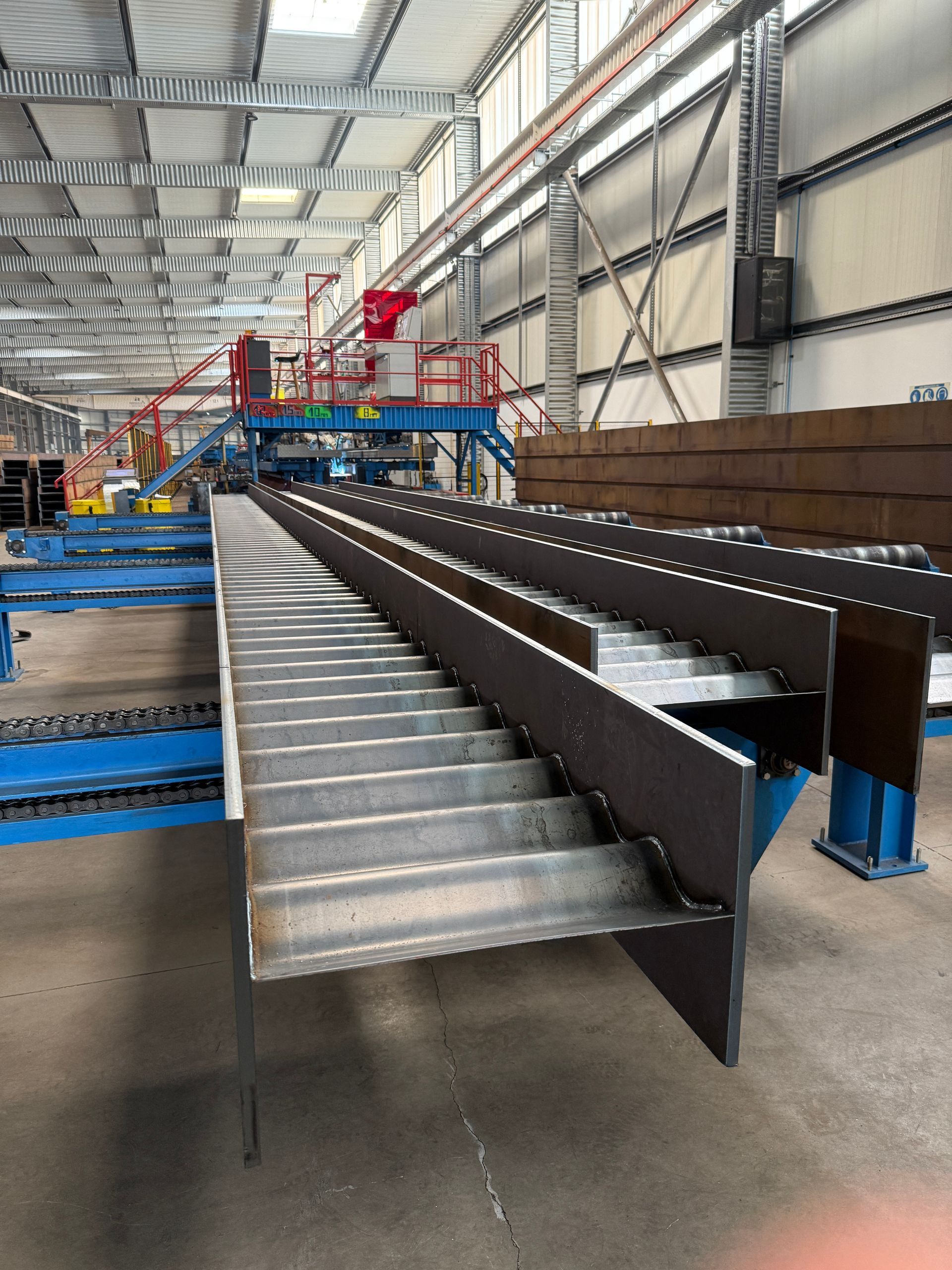
A conventional wide-flange beam has a flat web. The SpanCorr Beam replaces it with a corrugated, wave-shaped web. The corrugation resists shear buckling far more efficiently, so the web can be much thinner while the flanges carry the full bending load.
A flat web fails by elastic shear buckling — its capacity is limited by panel slenderness, which constrains how thin the web can be. The corrugated web eliminates this constraint. Each corrugation fold stabilizes the adjacent ones against out-of-plane movement, dramatically increasing the effective buckling resistance without adding material. The result is the same structural performance at 30–50% less steel by weight. Manufactured from A572 Gr. 50 flange plate and an A1008 Gr. 50 corrugated sinusoidal web. This behavior is codified in AISC 360-22 §F5 for flexure and EN 1993-1-5:2024 Cl. 13 for web shear.
Explore engineering resources →| Property | Details |
|---|---|
| Flange material | A572 Gr. 50 structural plate |
| Web material | A1008 Gr. 50 corrugated sinusoidal steel coil |
| Standard lengths | 30–65 ft in 5 ft increments |
| Web geometry | Sinusoidal corrugation profile, roll-formed on demand |
| Flexure design basis | AISC 360-22 §F5 |
| Web shear design basis | EN 1993-1-5:2024 Cl. 13, adopted via AISI S100-2024 §A1.2.6(c) |
| Weight savings | 30–50% lighter than comparable wide-flange members |
| Origin | Made in the USA |
Unlike rolled wide-flange sections that require mill scheduling, SpanCorr Beams are manufactured on demand. No roll dates. Your timeline, not the mill's.
Web material arrives as A1008 Gr. 50 steel coil. Flange plates are cut to dimension from A572 Gr. 50 structural plate. Both materials are standard, domestically sourced, and available on demand.
The coil passes through a corrugator once, forming the sinusoidal corrugation profile in a single pass. This geometry is what gives SpanCorr Beams their structural efficiency, distributing shear forces across the corrugated surface rather than relying on web thickness.
The corrugated web is welded to the flanges to produce the finished beam. Standard lengths run 30–65 ft in 5 ft increments. Because the beam is manufactured from plate and coil, design changes or new orders can be put on the production schedule immediately.
No. The governing code sections (AISC 360-22 §F5 for flexure and EN 1993-1-5:2024 Cl. 13 for web shear) are established provisions. The Beam Selector handles the section checks and outputs a summary engineers can review directly. Most EORs are reviewing and approving, not running calculations from scratch.
No. SpanCorr Beams arrive as finished members. Connections are standard shear connections (clip angles, shear tabs), no different from standard wide-flange detailing. There is no special tooling, no new weld procedure qualification, and no retraining required at the fab shop.
When conventional wide-flange material is on mill backorder or lead times are extended, SpanCorr can substitute directly. Because it is manufactured from plate and coil rather than rolled at a mill, orders can be placed on a standard production schedule, often when the W-shape option simply isn’t available in time.
That is the verified range across beam sizes and span conditions. Not every beam will hit 50%. The actual saving depends on the specific span, loading, and the W-shape being replaced. The Beam Selector shows the comparison for specific project conditions so you can see the actual saving before committing to a design direction.
SpanCorr Beams are most competitive on longer spans where W-shape webs become increasingly inefficient. Standard manufactured lengths run 30–65 ft in 5 ft increments. The Beam Selector will flag when a W-shape is more efficient at a given span. We are not trying to sell you a beam where it doesn’t make sense.
Less steel by weight means less embodied carbon, directly and proportionally. There is no published EPD yet, but the logic is straightforward: if your structural steel tonnage drops by 35%, your structural steel carbon footprint drops by roughly 35%. That is documentable on any LEED or carbon-reporting project without waiting for third-party verification.
A non-composite SpanCorr design has been found to outperform a composite wide-flange design on both weight and material cost. Multi-story office buildings are a prime example. Composite deck, shear studs, and the associated labor and coordination costs are a significant part of the structural budget. SpanCorr removes that layer entirely while still coming out cheaper than the conventional wide-flange design.
SpanCorr Beams are ideal for demanding building types where long spans, clear heights, and structural efficiency are critical.
Wide open bays, heavy roof loads, and clear height requirements. SpanCorr excels in industrial environments where every foot of span and every pound of steel tonnage affects the project budget.
High clear heights and column-free interiors are essential for racking, forklifts, and equipment staging. SpanCorr delivers the spans without the steel tonnage.
Precision floor loads, raised access floors, and dense MEP routing benefit from lighter structure and longer column-free bays. Schedule certainty is critical in hyperscaler timelines.
Flexible floor plans and long lease spans are achievable with fewer columns and lighter framing. In multi-story office buildings, a non-composite SpanCorr design can compete with composite wide-flange on weight, cost, and erection time by eliminating shear studs entirely.
Long-span roofs over courts, fields, and arenas. Structural steel weight drives cost and schedule more than almost anywhere else in these buildings.
Cost-sensitive projects benefit from a VE option that reduces tonnage, shortens erection time, and produces a smaller foundation. SpanCorr fits where budget pressure is highest.